Nishiki Market Kyoto Guide: Hours, Rules and What to Eat
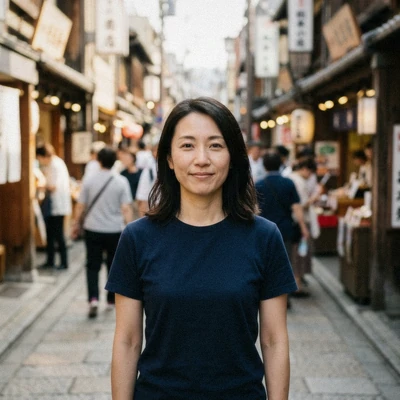
This Nishiki Market Kyoto guide starts with the shape of the place: a 390 metre covered arcade in central Kyoto that the local promotion association calls Kyoto no daidokoro, Kyoto's kitchen, with roughly 400 years of history as a place where fresh food changes hands. Guided Nishiki Market walks exist for a reason: more than 100 shops and stalls line the arcade with no posted map of what each one sells, and the market's own etiquette rules are easy to break without knowing it. This guide covers hours, the eating rule, what to actually order, and whether to walk it alone or with someone who already knows the stalls.
Quick answer
Nishiki Market is a 390 metre covered arcade with more than 100 shops and stalls, generally open from around 9am to 6pm though every shop sets its own hours, with many closing on Wednesdays and around 1 to 3 January. The market association asks visitors to eat what they buy in front of or inside the shop rather than while walking the arcade.
Key takeaways
- The arcade runs 390 metres end to end, roughly 400 years of continuous food trading
- There is no market-wide closing day; check individual shops, since many close Wednesdays
- Eating while walking is discouraged by the market association's own request, not a law
- Guided market walks here run $41 to $66, useful if you want the stalls explained rather than guessed at
- Tipping is not customary in Japan; a simple okini covers it
- For the fuller value question, see are Kyoto food tours worth it
Guided ways to walk Nishiki Market
Three real options if you would rather have the stalls explained than guess your way through them.
 from $50
Top Rated 4.8★
from $50
Top Rated 4.8★ Nishiki Market Food Tour & Gion Walk — 7 Tastings
A three-hour walking tour that pairs Gion's stone-paved streets with Nishiki Market, the centuries-old "Kitchen of Kyoto". Stop at Nishiki Tenmangu Shrine, then graze through 7 tastings among…
- 7 tastings of local delicacies inside Nishiki Market
- Walk Gion's machiya streets before diving into the market
- Nishiki Tenmangu Shrine and the market's Edo-period history
- Yuba, Kyoto vegetables and matcha — the ingredients behind Kyoto cuisine
 from $66
90-Minute Taster 4.5★
from $66
90-Minute Taster 4.5★ Nishiki Market Tour with a Local Foodie & Tastings
A compact 90-minute Nishiki Market tour led by a local foodie. Start at Nishiki Tenmangu, the shrine of learning, browse the lively Teramachi shopping arcade, then work through…
- Tastings hand-picked by a local foodie to match your palate
- Nishiki Tenmangu Shrine and the Teramachi arcade included
- 390 meters of stalls — fresh seafood, snacks and sweets
- Compact 90-minute format that fits a busy Kyoto day
 from $41
Same-Day Friendly 4.4★
from $41
Same-Day Friendly 4.4★ Nishiki Market & Depachika Food Tour with a Local
A two-hour walking tour combining Nishiki Market with a depachika — the dazzling gourmet food hall in a department store basement. Multiple daily start times and same-day booking…
- Nishiki Market and a depachika food hall in one walk
- Depachika basement counters — wagashi sweets to gourmet deli
- Ends at Nishiki Tenmangu Shrine, the market's hidden gem
- Multiple start times with same-day booking available
Which guided market walk fits which traveller
If You want the market explained plus a Gion stroll afterward
the Nishiki Market food tour and Gion walk, the Nishiki Market Food Tour & Gion Walk, at $50 for three hours
If You want a smaller group and a local foodie's own picks
The Nishiki Market tour with a local foodie at $66 for 90 minutes
If You want the market plus a department-store food hall stop
The Nishiki Market and depachika food tour at $41, meeting at the Apple Store on Shijo
If You would rather browse the dish canon first before choosing a walk
Read what to eat in Kyoto for the fuller list of Kyoto specialities beyond the market
If You want the market plus a food hall, ranked by rating
the Nishiki Market and depachika food tour with a local holds 4.4 stars across 85 reviews, a smaller but real sample size worth weighing against the Nishiki Market food tour and Gion walk's 79
What Nishiki Market is
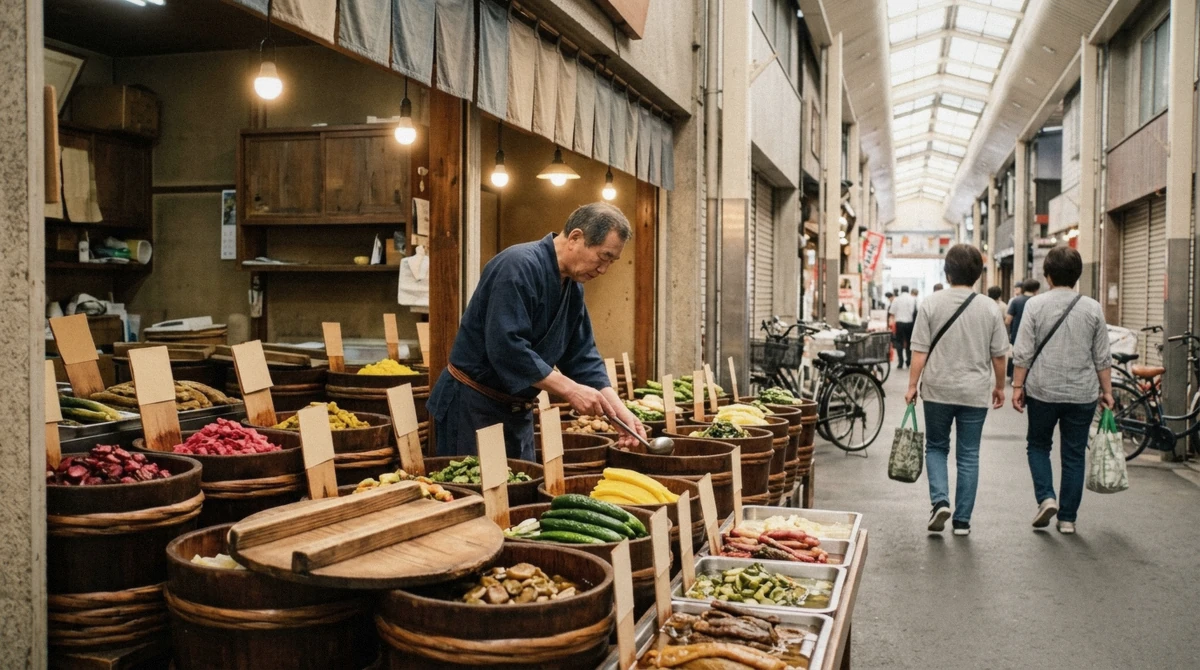
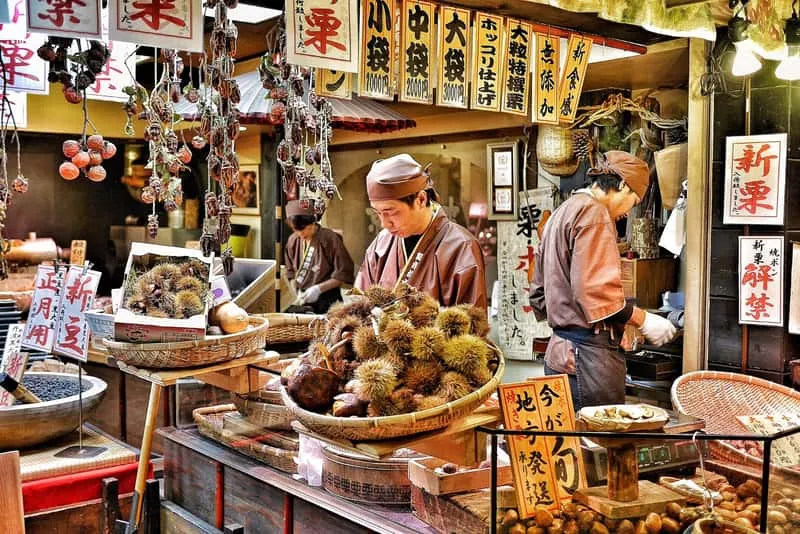
Nishiki Market is a single covered shopping street running 390 metres through central Kyoto, roughly parallel to Shijo-dori, one block north. The market association frames its own history as walking through 400 years of history, a place where fresh food has changed hands in the same location since long before the current stalls existed. Locals call it Kyoto no daidokoro, Kyoto's kitchen, and while the arcade has become a tourist stop, working households and restaurant buyers still shop here for dashi ingredients, pickles and fresh produce.
The association does not publish an exact shop count, so the honest figure is more than 100 shops and stalls rather than a precise number. At the eastern end, the arcade meets the Teramachi covered shopping street, where Nishiki Tenmangu shrine sits, a small working shrine wedged between storefronts that is easy to miss unless you are looking for it.
Hours, closing days and when to turn up
There is no single set of hours for the market as a whole, because each shop sets its own. Most trade roughly 9am to 6pm, but the association's own answer to the hours question is that it varies shop by shop, so a specific stall can be shut on a day the arcade around it is busy.
| Detail | What to expect |
|---|---|
| Typical hours | Roughly 9am to 6pm, varies by shop |
| Market-wide closing day | None; each shop sets its own |
| Common weekly closure | Many shops close on Wednesdays, some on Sundays |
| New Year closures | Many shops closed 1 to 3 January |
| Restroom | At the Promotion Association office, 10am to 5pm |
The busiest window is late morning through early afternoon, when both the stall owners and the crowd are at their fullest. If the goal is photographs and breathing room between stalls, arrive close to opening; if the goal is seeing the market at its most alive, go around midday and accept the crowd that comes with it. Last verified: August 2026.
The eating rule, and how to follow it
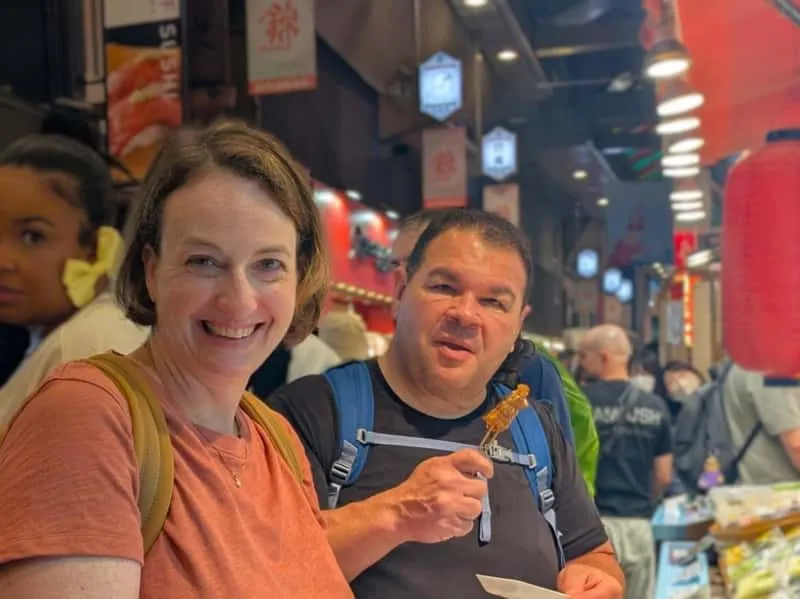
The market association asks visitors to refrain from eating while walking through the arcade, and instead to eat in front of or inside the shop where the food was bought. This is the promotion association's own shopping-street request, not a city law and not a fine, but it is real and worth following, both out of courtesy and because a crowded 390 metre arcade with people eating while moving is a genuine bottleneck. Many stalls have adapted by adding a small standing counter or a marked corner exactly for this reason.
- Buy from a stall, then step to its counter or the space just in front of it to eat
- Look for a small standing area before assuming there is nowhere to pause
- Finish or bin your stick, skewer or wrapper before moving to the next stall
- Do not carry a half-eaten skewer while browsing several stalls at once
- Do not assume every stall wants you eating directly in the doorway; ask if unclear
What to eat, stall by stall
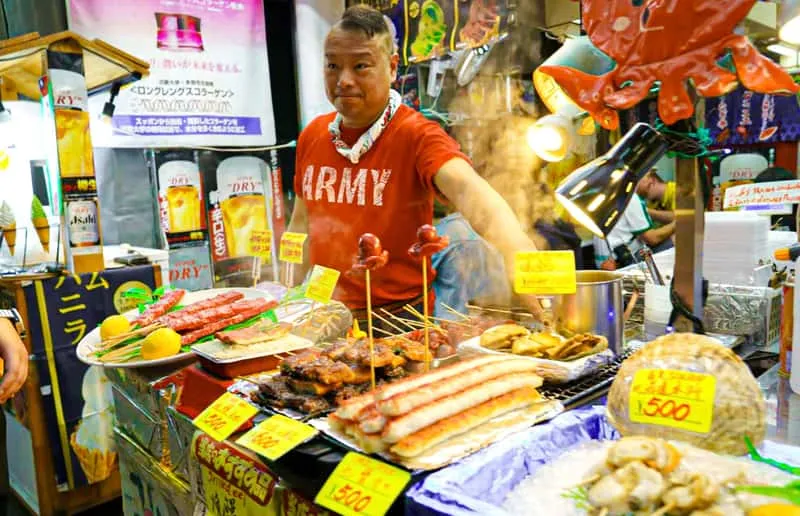
The arcade specialises in things you eat in one or two bites, standing or seated at a small counter, rather than a sit-down meal.
| Dish | What it is |
|---|---|
| Dashimaki tamago | A rolled omelette cooked with dashi stock, sold warm in slices |
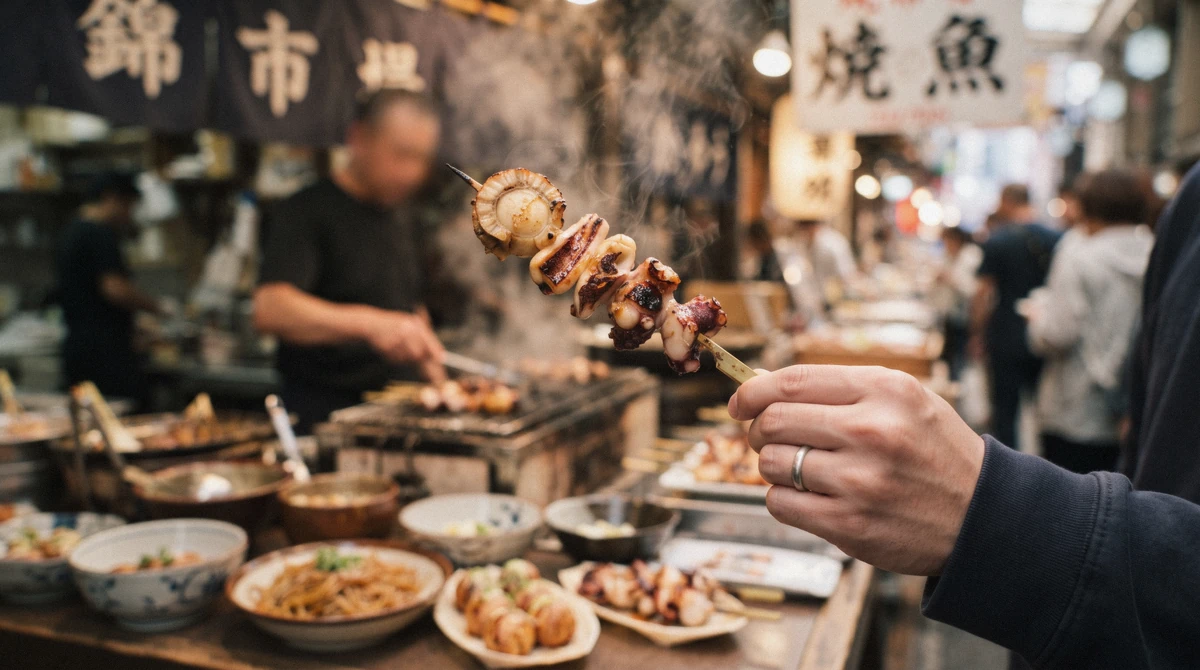
| Grilled seafood skewers | Scallop, sea bream or squid grilled to order over a small flame |
| Baby octopus with quail egg | A whole baby octopus stuffed with a quail egg set in the head, a Nishiki signature |
| Tsukemono | Kyoto pickles, especially shibazuke, senmaizuke and suguki, sold by weight |
| Fresh yuba | Soy milk skin served rolled or plain, a Kyoto speciality worth trying fresh |
| Matcha warabi mochi | A soft, matcha-dusted jelly sweet, usually eaten in a few bites |
| Soy-milk doughnuts | A modern market snack, freshly fried and sold hot |
Most of these are national or regional dishes, but the market has its own specialities worth seeking out: the pickle shops, several generations deep, and the yuba counters, which sell a version of the dish that is genuinely hard to find outside Kyoto. A reasonable route through the market covers savoury first, sweet last, since a matcha warabi mochi at the start of a walk tends to spoil the palate for everything savoury that follows.
Check dates for the Nishiki Market Food Tour & Gion Walk
A sensible two-hour route through the arcade
One reasonable order for a self-guided walk from the west end near Teramachi to the eastern entrance, paced so the last stop is not rushed.
-
0:00
Enter from the western end
Start at the quieter western entrance rather than fighting the crowd from the busy Teramachi side first.
-
0:15
Savoury first
Stop at a dashimaki tamago or grilled skewer stall early, while you are hungriest and the queue is shortest.
-
0:45
Pickle and yuba stalls
Browse the tsukemono and fresh yuba counters in the middle stretch, where several shops sit close together for easy comparison.
-
1:15
A proper pause
Eat what you have bought at a standing counter rather than carrying it, per the market's own request.
-
1:40
Sweets last
Finish with matcha warabi mochi or a soy-milk doughnut near the eastern stretch, once the savoury tasting is done.
-
2:00
Exit at Nishiki Tenmangu
End at the shrine where the arcade meets Teramachi, a natural stopping point before continuing into the covered shopping street beyond.
Paying, queueing and photographs
Cash still matters at small market stalls, even though card and IC card acceptance has spread in recent years; carry some 1,000 yen notes so a small purchase does not become a problem. Queues at the busiest stalls move quickly, usually a minute or two, and it is normal to order by pointing if your Japanese is limited. Photographing the food and stalls themselves is generally fine and common; photographing individual shopkeepers or other customers up close without asking is not, and is worth avoiding out of ordinary courtesy rather than any posted rule specific to the market.
A dedicated Wi-Fi network is not guaranteed inside the arcade, so it helps to have a route in mind or a screenshot of a stall list before you lose signal in the middle of a crowd. The narrow width of the arcade also means strollers and large luggage are genuinely awkward; leave bags at the hotel if you can, since there is nowhere in the market itself to store them.
Tipping and the rest of the etiquette
Tipping is not customary in Japan and can cause confusion or offence; there is no system in place for it, and a stallholder may hand the money straight back rather than accept it. Kyoto's own visitor etiquette guidance suggests saying okini, thank you in the Kansai dialect, instead of leaving money. Slurping is not an issue here since most Nishiki food is eaten standing rather than with noodles, but the arcade's own request to eat where you bought it, covered above, is the etiquette point that trips up the most first-time visitors.
- Say okini rather than reaching for cash to tip a stallholder
- Eat what you buy at or near the stall, not while continuing to browse
- Keep bags and elbows in during the busiest midday stretch; the arcade is narrow
- Ask before photographing a shopkeeper directly, even if the food display itself is fair game
Walking it yourself versus walking it with a guide
Walking it yourself
- Free beyond what you buy, typically 2,000 to 4,000 yen for a light graze
- Total control over pace and which stalls you stop at
- No schedule to keep, so you can double back for a stall you skipped
- Requires guessing at unfamiliar stalls or using a translation app stall by stall
Walking it with a guide
- $41 to $66 depending on the route and group size
- Every dish explained before you commit to trying it
- A guide who already knows which stalls are worth the wait and which are not
- Fixed schedule shared with a small group, less room to linger
Verdict Walk it yourself if you enjoy figuring things out and want to move at your own pace. Book a guide if you would rather spend two hours eating well than two hours guessing, especially on a first visit. Either way, it helps to see every Kyoto food tour before you decide, since the market walks are only part of what is on offer here.
Frequently Asked Questions
What time does Nishiki Market open and close?
Most shops trade roughly 9am to 6pm, but hours vary shop by shop since there is no single set schedule for the whole arcade.
Which day is Nishiki Market closed?
There is no market-wide closing day. Many individual shops close on Wednesdays, some on Sundays, and many close around 1 to 3 January.
Can you eat while walking through Nishiki Market?
The market association asks visitors not to, and to eat in front of or inside the shop where the food was bought instead. It is a shopping-street request, not a law.
How long do you need at Nishiki Market?
About two hours covers a relaxed self-guided walk end to end with several tasting stops; a guided market walk on this site typically runs 1.5 to 2 hours for a more curated version of the same ground.
Do you tip in Kyoto restaurants and markets?
No. Tipping is not customary anywhere in Japan, there is no system for handling it in restaurants or at market stalls, and staff will often chase you down the street to return money you left behind. Kyoto's own visitor guidance puts it plainly: say okini, the Kansai thank you, rather than leaving a tip. The same holds on a guided walk, where the guide is paid by the operator. If a guide made your morning, the thing that actually helps them is a review. In many small Kyoto restaurants you will also take the bill to the cashier by the door rather than paying at the table.
Is Nishiki Market worth visiting if you already know Japanese food well?
Yes, mostly for the pickle and yuba specialists, which are genuinely Kyoto specialities rather than food found everywhere in Japan. A guide adds the most value for readers who cannot identify what a given stall sells at a glance.
What is the best time of day to visit Nishiki Market?
Close to opening for a quieter walk, or midday if you want the market at its liveliest and do not mind the crowd that comes with it.